About
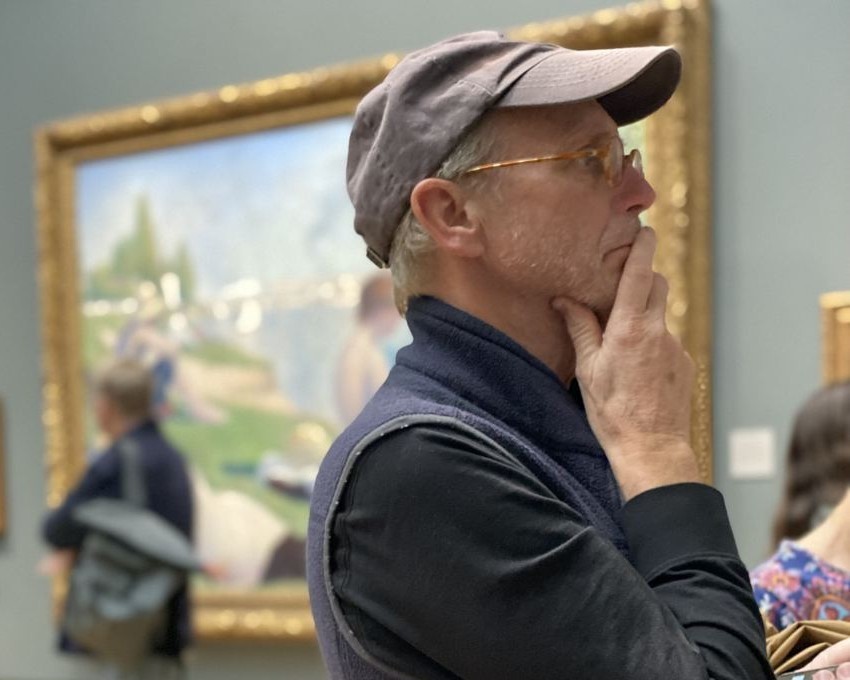
It’s all connected in hindsight.
He's been noticing things most people don't, since long before he had a word for it — though none of it looked connected while it was happening. It only resolves into one thread looking backward.
He's been noticing things most people don't, since long before he had a word for it — though none of it looked connected while it was happening. It only resolves into one thread looking backward.
As a boy, he avoided the attic in his grandparents’ old brick farmhouse — built in the late 1700s from bricks made on the property — and a small room off the parlor that never felt inviting either. Nothing he could explain. He let it go the way children do: a feeling, not a fact.
At fifteen, on his family’s tobacco farm in Tennessee, came something harder to wave off — lightning struck the tongue of the trailer he was standing on, between him and his brother. At the time it was just a scare, nothing to connect to a boy who didn’t like an attic. Years later, in college, came a moment that should have been the clearest warning yet, except it still didn’t add up to anything. Curious whether a neon sign gave off heat, he reached out toward it, and came to sitting on the sidewalk with his back against the building, with no memory of how he got there — the same unnamed feeling from the attic, now paired with something electrical.
“The same unnamed feeling from the attic, now paired with something electrical.”
It wasn’t until years later, in an apartment in Brattleboro, Vermont, that the pattern finally had a name. Hooking his computer to a new backup battery, he noticed his fingertips tingling at the keyboard. His wife, using the same computer, felt nothing. Same setup, same room — one variable different: him. Two decades of separate incidents resolved into one plain fact.
By then, Bobby had already left medical school in his first year, convinced by one instructor’s own admission — that most of what physicians do is manage discomfort while the body heals itself — that he’d rather work with that healing directly than mask it. He spent the years after chasing that same conviction through two careers: tracing invisible contamination through groundwater as a hydrogeologist, then spending two decades as a chiropractor, watching patients improve in his office only to backslide within days of going home.
Along the way, he trained in Reiki and honed a skill in muscle testing that’s still part of how he works with clients today.
The moment his own sensitivity became impossible to ignore arrived in his own office. He’d upgraded the equipment — a wireless network, patient charts moved onto a web-based program on an iPad — and within weeks he couldn’t work past four hours without feeling drained: foggy, mentally exhausted, in a way sleep didn’t touch. He turned the Wi-Fi off and went back to writing his notes by hand. In a short period of time, the fatigue lifted, and he was back to working full days.
That confirmed the cause — but it wasn’t a real fix. Pen and paper isn’t how a modern practice runs, and it wasn’t something he could hand to a client living with the same problem. So he went looking for one. The usual fixes — grounding mats, phone stickers, a device that promised to override man-made frequencies with the earth’s own — never gave him anything consistent. A colleague pointed him toward BioGeometry®. He did his own research, and decided to train in the field himself. Once trained, he tested it first in his own bedroom, where his wife had woken at 1:30 or 2 a.m. for years, unable to fall back asleep — until, once he addressed what he found, she didn’t anymore. That house — 115 years old, and the place where BioGeometry® first proved itself to him — has its own story, told in full on the Beyond page.
Bobby is a licensed BioGeometry®-EHS Associate-Practitioner based in the Pacific Northwest. What he brings to that training, he calls Call and Response — the same instinct that’s been with him since the attic, sharpened by two careers and proven on himself before he ever offered it to a client.
It fails because the body never gets permission to do it.
Your nervous system runs on two settings, and both matter. The sympathetic branch is the alert one — it speeds up your heart, sharpens your senses, and gets you ready to act, which is exactly what you want when there’s something real to respond to. The parasympathetic branch is the opposite: it slows the heart, deepens the breath, and hands the body over to digestion, immune response, and tissue repair — the maintenance work that can only happen once nothing urgent is asking for attention. Neither state is the problem. The problem is getting stuck in the first one when there’s nothing left to actually be alert about.
A home under geopathic and electromagnetic stress can do exactly that — keep the nervous system in a low-grade state of vigilance, quietly, all night, the same state that keeps an animal from resting near a predator. A body that can’t shift into parasympathetic can’t reach the depth of sleep where real repair happens.
Bobby’s work isn’t to fix you. It’s to give your body back a place safe enough to do what it already knows how to do.
Spaces Within offers home assessments using BioGeometry®, a research-based approach to identifying and rebalancing the subtle qualities of a space.
Bobby examines these as interconnected factors shaping how you sleep, think, and heal.
What you’ve noticed about your sleep, your space, how different rooms make you feel. It’s the same starting point whether the work that follows is a single room or the whole home, and it doesn’t commit either of us to anything further — it’s simply where we figure out if this is the right fit.
A systematic home assessment identifies stressors and places precise geometric solutions to rebalance what’s found.
Bobby returns two to three weeks later to verify the work — not because anything is unfinished, but because bodies take time to respond to a changed environment.
This isn’t feng shui, smudging, or crystal placement — though Bobby doesn’t discount them. It’s quiet, methodical work: measure the space, place a solution, re-measure, adjust. Call and response, until the reading settles.
The first call is free, and it’s the same starting point no matter how much or how little work follows.
Book a Free Call Not ready yet? Take the self‑assessment first →“The light needs somewhere to land.”